The Complete Local SEO Guide for Service Businesses in 2026
Google Business Profile optimisation, local link building, review velocity and AI search visibility. Everything you need to dominate your local map pack.
Key Takeaways
- 46% of all Google searches have local intent, making local SEO the highest-ROI channel for service businesses.
- Your Google Business Profile is the single most important local ranking factor. Complete every field, post weekly, and maintain a review velocity of 8+ reviews per month.
- Review velocity (how fast you accumulate reviews) matters more than total review count. Businesses in the top 3 map pack positions average 47 reviews per month.
- Local citations and consistent NAP (Name, Address, Phone) across 40+ directories signals trust to Google's algorithm.
- AI search engines like Google AI Overviews and ChatGPT now surface local businesses. Structured data and review content are the primary signals they use.
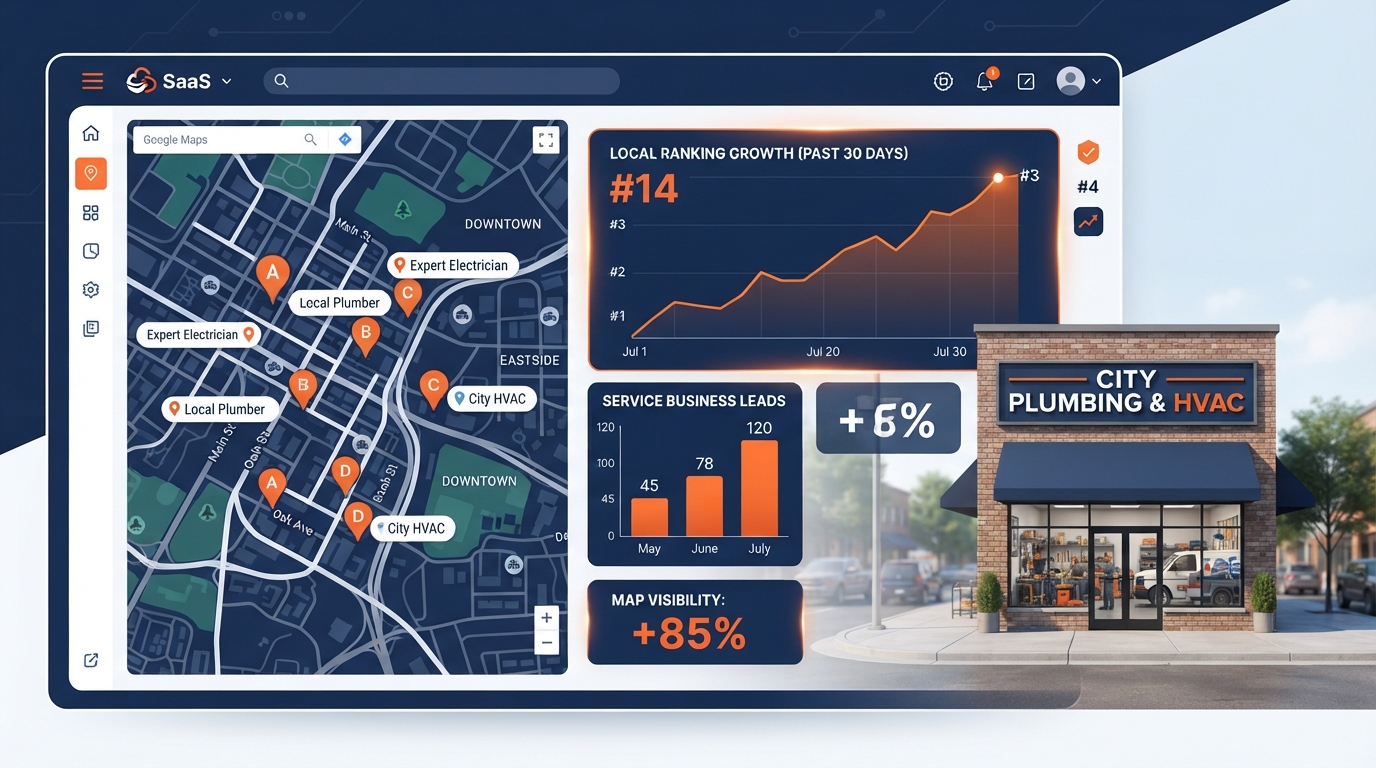
If you run a service business, your customers are searching for you locally. According to Google's own data, 46% of all searches have local intent. When someone searches 'plumber near me' or 'roofing company in [city]', Google shows a map pack of three businesses above the organic results. If you are not in those three positions, you are losing customers to competitors who are.
Local SEO is the practice of optimising your online presence so your business appears in those local search results. It is different from traditional SEO because it prioritises geographic proximity, Google Business Profile signals, and review activity over content and backlinks. In this guide, we cover everything you need to know to dominate local search in 2026.
How Local Search Ranking Works
Google's local search algorithm uses three primary factors to determine which businesses appear in the map pack: relevance, distance, and prominence. Understanding how each works is the foundation of any local SEO strategy.
Relevance
Relevance measures how well your business matches what the searcher is looking for. This is determined by your Google Business Profile categories, your website content, and the keywords used in your reviews. If you are a plumber but your primary category is set to 'Contractor', Google will not rank you for 'plumber near me' searches. Category accuracy is non-negotiable.
Distance
Distance considers how far your business is from the searcher's location or the location they specified in their search. You cannot change where your customers are, but you can influence this factor by ensuring your service area is accurately defined in your Google Business Profile and by creating location-specific landing pages for each area you serve.
Prominence
Prominence measures how well-known and trusted your business is, both online and offline. This is influenced by your review count and rating, the quality and quantity of backlinks to your website, your overall organic search ranking, and how often your business is mentioned across the web. Prominence is where most local SEO effort goes, because it is the factor you have the most control over.
46%
of all Google searches have local intent, according to Google's own search data
Google Business Profile Optimisation
Your Google Business Profile (formerly Google My Business) is the single most important element of local SEO. It is the first thing potential customers see when they search for your business, and it is the primary signal Google uses to determine local ranking. Here is how to optimise it fully.
Complete Every Field
Businesses that complete all Google Business Profile fields receive 7x more clicks than those with incomplete profiles, according to BrightLocal research. This includes your business description, services list, products, attributes (such as 'women-led' or 'online appointments'), opening hours, service area, and photos. Every field you leave empty is a signal you are sending to Google that you are less relevant than a competitor who filled it in.
Post Weekly
Google Business Profile posts (updates, offers, events) signal activity to Google's algorithm. Businesses that post at least once per week see measurably better local ranking performance than those that post irregularly. Posts also occupy real estate on your profile, pushing competitors' ads and other distractions further down the page.
Use High-Quality Photos
Businesses with more than 100 photos on their Google Business Profile receive 520% more calls than those with fewer than 25, according to BrightLocal. Use real photos of your team, your work, your vehicles, and your premises. Avoid stock photos. Google's algorithm can detect stock imagery and it does not help your ranking.
7x
more clicks for businesses with complete Google Business Profiles versus incomplete ones
Review Strategy: Velocity Over Volume
Reviews are the second most important local ranking factor after your Google Business Profile. But the common assumption that you need hundreds of reviews to rank well is wrong. What matters more is review velocity: how consistently you receive new reviews over time.
BrightLocal's Consumer Review Survey highlights that review recency and velocity are major local ranking factors. Businesses ranking in the top map pack positions tend to accumulate reviews far faster than lower-ranked competitors. This is not because they have been around longer. It is because they have a system for requesting reviews from every satisfied customer. A business with 200 total reviews but only 2 in the last month will rank below a business with 150 total reviews and 15 in the last month.
How to Build Review Velocity
- Ask every customer for a review within 24 hours of job completion, when satisfaction is highest
- Send a review request via SMS, which has a 98% open rate versus 20% for email
- Make the review link direct to your Google Business Profile review page, not your homepage
- Respond to every review within 24 hours, positive or negative. Google rewards businesses that respond
- Automate the request process so no satisfied customer is missed
47
average new reviews per month for businesses ranking in the top 3 map pack positions
Local Citations and NAP Consistency
A local citation is any online mention of your business name, address, and phone number (NAP). Google uses citations to verify that your business information is accurate and consistent across the web. Inconsistent NAP information confuses Google's algorithm and damages your local ranking.
Your NAP should be identical on your website, your Google Business Profile, and across at least 40 local directories. The most important directories for UK service businesses are Yell, Yelp, Thomson Local, FreeIndex, Cylex, and industry-specific directories. Use the exact same format for your business name, the exact same address format, and the exact same phone number everywhere.
Common NAP Mistakes
- Using 'Ltd' on your website but 'Limited' on directories
- Listing a different phone number on your Google Business Profile than on your website
- Using a different address format (e.g. 'Street' vs 'St') across directories
- Having multiple Google Business Profiles for the same business at the same address
- Not updating directory listings when you move premises or change phone numbers
On-Page Local SEO
Your website plays a critical role in local SEO, even though the map pack is driven primarily by your Google Business Profile. Google cross-references your website content with your profile to confirm relevance and prominence. Here are the on-page elements that matter most for local search.
Location Pages
Create a dedicated page for each location or service area you cover. Each page should include the location name in the title tag, H1, and URL. The content should be unique and specific to that area, not generic text duplicated across pages with just the location name swapped. Include testimonials from customers in that area, photos of jobs completed there, and location-specific FAQs.
Schema Markup
Add LocalBusiness schema markup to your website's homepage and location pages. This structured data tells Google exactly what your business is, where it is, what services you offer, and what your opening hours are. Schema markup does not directly improve rankings, but it helps Google understand your business accurately, which improves how you appear in search results.
Title Tags and Meta Descriptions
Include your primary service and location in your title tags. The format 'Service in Location | Business Name' consistently outperforms alternatives. Keep title tags under 60 characters. Write meta descriptions that include your location and a clear call to action, keeping them under 155 characters.
AI Search Visibility: The New Local SEO Frontier
In 2026, local SEO extends beyond Google's traditional search results. AI search engines like Google AI Overviews, ChatGPT, and Perplexity now answer user queries directly, often recommending specific businesses. When a user asks ChatGPT for a 'reliable plumber in North London', the AI recommends businesses based on their online presence, review content, and structured data.
To appear in AI search recommendations, your business needs three things: comprehensive and accurate structured data (schema markup), detailed and specific review content (AI reads review text to understand what your business does well), and a strong presence across the web (AI engines aggregate information from multiple sources, not just Google).
How AI Search Differs From Traditional Search
- Traditional search returns a list of links. AI search returns a direct answer, often naming specific businesses.
- Traditional search ranks pages. AI search ranks entities (your business as a whole, not just your website).
- Traditional search relies on keywords and backlinks. AI search relies on entity recognition, review content, and structured data.
- Traditional search shows 10 results. AI search typically recommends 1-3 businesses, making the stakes higher.
Measuring Local SEO Performance
The metrics that matter for local SEO are different from traditional SEO. Track these key indicators monthly:
- Map pack ranking for your primary keywords (track weekly using a local rank tracker)
- Google Business Profile insights: searches, views, calls, direction requests, and website clicks
- Review velocity: new reviews per month and average rating
- Organic traffic to location pages from local search terms
- Phone calls and form enquiries attributed to local search (use call tracking to measure this)
- Conversion rate from Google Business Profile visits to enquiries
Common Local SEO Mistakes to Avoid
After auditing hundreds of service businesses, the same mistakes appear repeatedly. Avoid these and you will be ahead of most of your competitors:
- Incomplete Google Business Profile (missing services, attributes, or photos)
- Inconsistent NAP across directories and website
- No system for requesting reviews, resulting in low review velocity
- Duplicate Google Business Profiles for the same business
- Using a virtual office address that does not match your actual business location
- No location-specific landing pages for service areas
- Ignoring Google Business Profile posts and updates
- Not responding to negative reviews professionally and promptly
Getting Started: A 90-Day Local SEO Plan
If you are starting from scratch or fixing a neglected local SEO presence, here is a practical 90-day plan that produces measurable results:
Days 1-30: Foundation
- Claim and verify your Google Business Profile if you have not already
- Complete every field: categories, services, attributes, hours, service area, description
- Upload at least 20 high-quality photos of your work, team, and premises
- Audit and fix NAP consistency across your website and top 10 directories
- Set up a review request system (SMS-based) and start requesting reviews from every completed job
Days 31-60: Optimisation
- Create or update location pages for each service area with unique content
- Add LocalBusiness schema markup to your website
- Build citations on 30+ local directories with consistent NAP
- Start posting weekly on your Google Business Profile
- Respond to all existing reviews (positive and negative) and maintain a response habit going forward
Days 61-90: Growth
- Target 8+ new reviews per month through automated requests
- Build local backlinks through chamber of commerce, local sponsorships, and industry associations
- Monitor map pack rankings weekly and adjust strategy based on movement
- Add FAQ schema to location pages to improve AI search visibility
- Measure calls, enquiries, and bookings attributed to local search
Local SEO is not a one-time project. It is an ongoing practice. The businesses that win in local search are the ones that treat it like a system, not a campaign.
— Business Relauncher SEO Team