Cart Abandonment Recovery: The £40K You Are Leaving on the Table
Most ecommerce stores recover fewer than 10% of abandoned carts. With the right sequence, you can recover 25-35%. Here is the framework.
Key Takeaways
- The average cart abandonment rate is 70.2%, meaning 7 out of 10 shoppers leave without completing their purchase.
- Most ecommerce stores recover fewer than 10% of abandoned carts, but a well-structured 3-message sequence recovers 25-35%.
- The first recovery message should be sent within 1 hour of abandonment, when intent is highest, and recovers the most revenue.
- SMS cart recovery messages have a 98% open rate versus 20% for email, making SMS the highest-converting recovery channel.
- For a store generating £160K per month in revenue, recovering 30% of abandoned carts adds approximately £40K in monthly recovered revenue.
The average cart abandonment rate across ecommerce is 70.2%. That means 7 out of every 10 shoppers who add something to their cart leave without completing the purchase. If your store generates £160,000 per month in completed sales, you are leaving approximately £376,000 in abandoned carts on the table each month. Most stores recover fewer than 10% of that. With the right recovery sequence, you can recover 25-35%. That is an additional £40,000 to £53,000 per month in revenue you are already generating traffic for.
70.2%
average cart abandonment rate across ecommerce, per Baymard Institute research across 49 studies
Cart abandonment is not a sign that your traffic is low quality or your products are wrong. It is a sign that something in the checkout process created friction. The most common causes, according to Baymard Institute's research across 49 studies, are unexpected shipping costs (48%), being required to create an account (24%), slow delivery times (22%), and a long or complicated checkout process (17%). Recovery is about removing that friction and bringing the shopper back.
The 3-Message Recovery Sequence
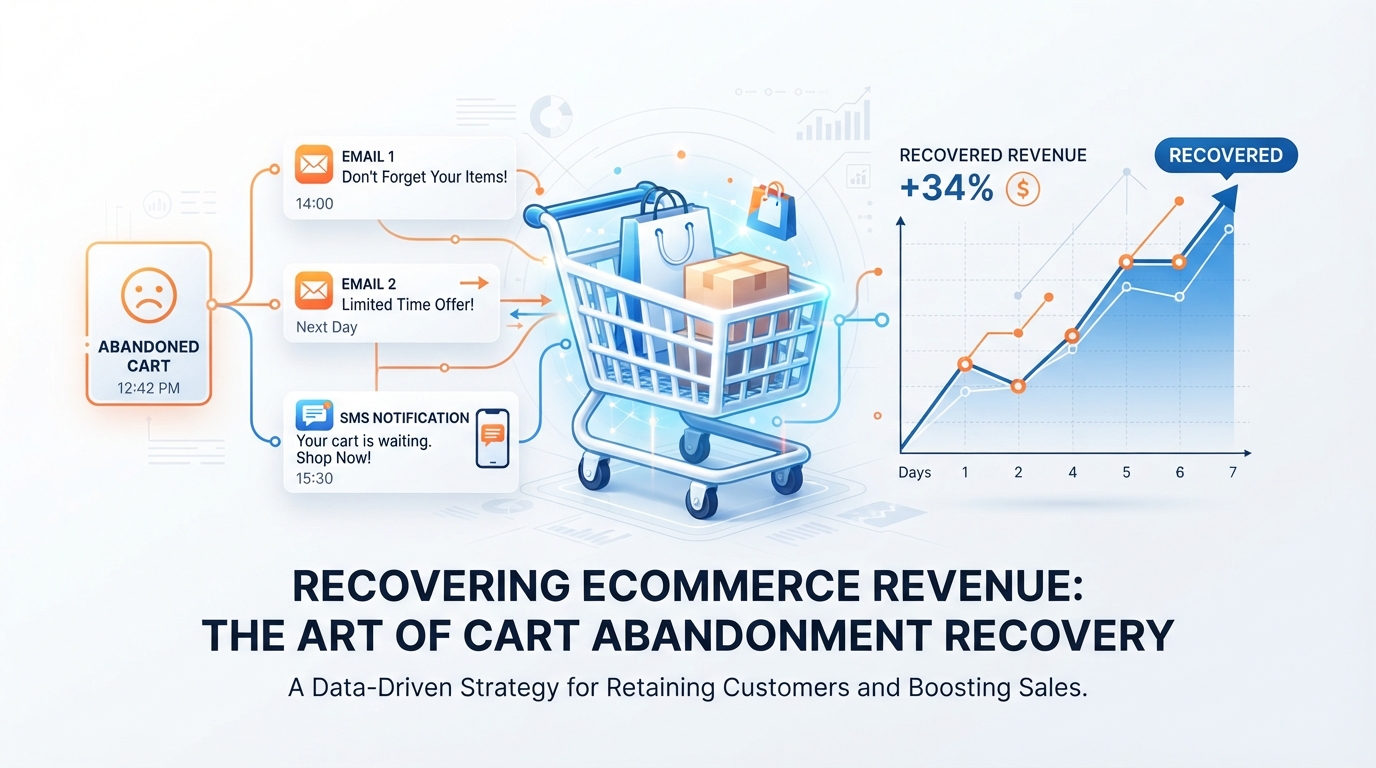
The most effective cart recovery sequence uses three messages sent over 48 hours. Each message has a different purpose, tone, and offer. Together, they recover 25-35% of abandoned carts when executed correctly. Here is the structure.
Message 1: The Reminder (Within 1 Hour)
The first message should be sent within 1 hour of abandonment, when purchase intent is still high. This message is a simple, friendly reminder. No discount, no urgency, no pressure. The goal is to make it as easy as possible for the shopper to return and complete their purchase.
The subject line should be direct and personal. 'You left something behind' or 'Still thinking it over?' both work well. The email should include a clear image of the abandoned product, the price, and a prominent 'Continue Shopping' or 'Complete Your Order' button that links directly to the checkout page with the cart pre-filled.
Message 1 Structure
- Send within 1 hour of abandonment, when intent is highest.
- Subject line: 'You left something behind' or 'Still thinking it over?'
- Include a product image, price, and a direct link to the pre-filled checkout page.
- No discount offer. This message is a simple, friendly reminder.
- This message alone recovers 10-15% of abandoned carts.
10-15%
of abandoned carts recovered by the first reminder message alone, sent within 1 hour
Message 2: The Objection Handler (24 Hours Later)
If the shopper has not returned after 24 hours, something is holding them back. The second message addresses the most common objections directly: shipping costs, delivery time, and product questions. This is where you remove friction.
The email should answer the questions the shopper is likely asking: 'How much is shipping?' 'When will it arrive?' 'What if I do not like it?' Include your shipping policy, estimated delivery dates, and return policy prominently. If you offer free shipping, say so. If you have a money-back guarantee, highlight it. The goal is to eliminate every reason the shopper might have for not completing the purchase.
Message 2 Structure
- Send 24 hours after abandonment, if the shopper has not returned.
- Address the top 3 objections: shipping cost, delivery time, and returns.
- Include shipping policy, estimated delivery dates, and return guarantee.
- Still no discount offer. This message builds trust and removes friction.
- This message recovers an additional 8-12% of abandoned carts.
Message 3: The Incentive (48 Hours Later)
If the shopper has not returned after 48 hours, a small incentive can close the gap. This is the only message in the sequence that includes a discount. The discount should be small (5-10%) and time-limited (24 hours). The goal is not to train shoppers to wait for discounts, but to give the final nudge to shoppers who are on the fence.
The subject line should create urgency without being aggressive. 'A small gift to help you decide' or 'Your cart is expiring soon' both work well. The email should include the discount code prominently, the product image and price (with the discount applied), and a clear deadline. This message recovers an additional 5-8% of abandoned carts.
Message 3 Structure
- Send 48 hours after abandonment, if the shopper has not returned.
- Offer a small, time-limited discount (5-10% off, valid for 24 hours).
- Subject line: 'A small gift to help you decide' or 'Your cart is expiring soon'.
- Include the discount code, product image, and discounted price.
- This message recovers an additional 5-8% of abandoned carts.
SMS: The Highest-Converting Recovery Channel
Email is the default recovery channel, but SMS is dramatically more effective. SMS messages have a 98% open rate versus 20% for email, and SMS recovery messages are typically read within 3 minutes of being sent. For shoppers who have opted in to SMS marketing, a single SMS reminder sent within 30 minutes of abandonment can recover 15-20% of carts on its own.
The most effective approach is to combine email and SMS. Send the first email reminder within 1 hour, then an SMS reminder 2 hours later for shoppers who have not returned. The SMS should be short, friendly, and include a direct link to the checkout page. 'Hi [Name], you left [Product] in your cart. Tap here to complete your order: [link]' is all you need.
98%
open rate for SMS messages, versus 20% for email, making SMS the highest-converting cart recovery channel
The Math: How £40K in Recovered Revenue Works
Here is a realistic example. A store generates £160,000 per month in completed sales. With a 70.2% cart abandonment rate, the total cart value is approximately £536,000, meaning £376,000 is abandoned each month. If the store recovers 10% (the industry average), that is £37,600 in recovered revenue. If the store implements the 3-message sequence and recovers 30%, that is £112,800 in recovered revenue. The difference is £75,200 per month, or approximately £40K in additional recovered revenue beyond what the store was already capturing.
The exact numbers will vary based on your store's traffic, average order value, and current recovery rate. But the principle is the same: you are already paying to generate the traffic that fills those carts. Recovering even 25% of abandoned carts is revenue you have already spent money to acquire. It is the highest-ROI work you can do in ecommerce.
How to Implement This in Your Store
Most ecommerce platforms (Shopify, WooCommerce, BigCommerce) have built-in cart recovery tools, but they are basic. They send a single email and stop. To implement the 3-message sequence with SMS, you need a connected automation system that tracks cart abandonment, triggers timed messages across email and SMS, and personalises each message with the abandoned product details.
If you are using Shopify, you can use Shopify Flow or a third-party app to build the sequence. If you are using WooCommerce, you can use AutomateWoo or a similar plugin. The key is to connect your store to a system that can trigger messages based on cart events, not just send a one-off email. The sequence should be automated, so every abandoned cart is followed up without manual intervention.