Review Automation: How More Reviews Can Drive More Enquiries
Reviews are the fastest trust signal you can build. We show how automated review requests can increase enquiry volume, illustrated through a representative service business example.
Key Takeaways
- Businesses ranking in the top Google map pack positions tend to accumulate reviews far faster than lower-ranked competitors, making review velocity a critical local ranking factor.
- SMS-based review requests have a 98% open rate versus 20% for email, making SMS the most effective channel for generating reviews.
- Automated review requests sent within 24 hours of job completion generate 3-5x more reviews than manual requests.
- In a representative engagement, a service business saw a 31% increase in enquiry volume within 90 days of implementing automated review requests.
- Review content (what customers say) matters as much as review count for AI search visibility, as AI engines read review text to understand your business.
Reviews are the fastest trust signal a business can build. They improve your local search ranking, increase conversion rates on your website, influence AI search recommendations, and give potential customers the confidence to pick up the phone. Yet most service businesses do not have a system for generating them. They rely on happy customers to leave reviews on their own, which happens less than 5% of the time.
In this article, we show how implementing automated review requests can transform enquiry volume. To illustrate the approach, we use a representative example based on a service business generating approximately £1.2M annually, and walk through exactly what we did, why it worked, and how you can replicate the results.
The Starting Point: A Review Problem
Consider a representative home services business generating approximately £1.2M annually. They had been in business for 8 years and had completed over 3,000 jobs. Their Google Business Profile had 42 reviews with an average rating of 4.7 stars. On the surface, this seemed reasonable. But when we dug into the data, the problem became clear.
They had received only 3 new reviews in the previous 6 months. Their review velocity (new reviews per month) was 0.5. Competitors in their area were accumulating 8-15 new reviews per month. Google's local search algorithm prioritises recent review activity over total review count, so the client was steadily losing map pack ranking to competitors with fewer total reviews but higher velocity.
0.5
new reviews per month before automation, versus a far higher velocity for top-ranking competitors
Why Manual Review Requests Do Not Work
The business was asking customers for reviews manually. The office manager would send an email to each customer after a job was completed, requesting a review. The problem was threefold:
- Timing: Emails were sent days after the job, when the customer's satisfaction had already faded and the urgency to leave a review had passed.
- Channel: Email review requests have a 20% open rate. Most customers never saw the request.
- Consistency: The office manager was busy. On weeks with high job volume, review requests were skipped entirely. Some satisfied customers were asked, most were not.
The result was a review generation process that captured less than 5% of satisfied customers. The business was completing 40-50 jobs per month and generating 0.5 reviews per month. Over 95% of happy customers were never asked at the right time, in the right way.
The Automated Review System
We implemented an automated review request workflow that addressed all three problems. Here is exactly what we built.
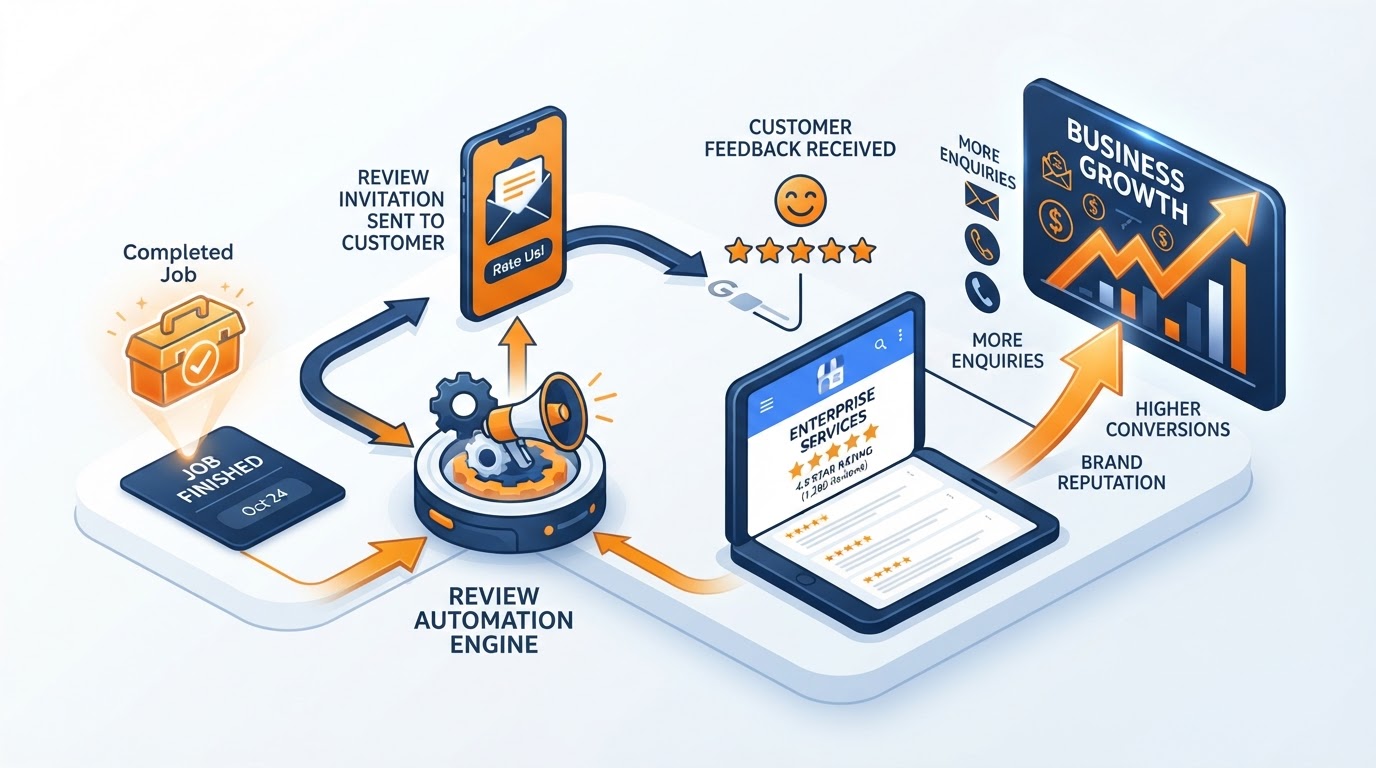
Step 1: Trigger on Job Completion
When a job was marked as complete in the CRM, the system automatically triggered a review request sequence. This ensured that every single completed job generated a review request, with no manual intervention required. The trigger was tied to the CRM status change, so nothing was missed.
Step 2: SMS First, Email Second
The first review request was sent via SMS 24 hours after job completion. SMS has a 98% open rate versus 20% for email, making it dramatically more effective for review generation. The message was short, personalised, and included a direct link to the Google Business Profile review page.
If no review was left within 3 days, the system sent a follow-up email with a slightly different message. This two-touch approach captured customers who missed the SMS or needed a second nudge. The email also included the review link directly, reducing friction to a single click.
98%
open rate for SMS review requests versus 20% for email
Step 3: Direct Link to Review Page
The review link went directly to the Google Business Profile review form, not the business homepage. Every extra click between the request and the review form reduces conversion. By linking directly to the form, we removed all friction. The customer clicked the link, saw the star rating selector, and could leave a review in under 60 seconds.
Step 4: Response Automation
Every review, positive or negative, triggered a notification to the office manager. For positive reviews (4-5 stars), the system drafted a response template that the manager could approve and send with one click. For negative reviews (1-3 stars), the system sent an internal alert so the team could reach out to the customer privately before responding publicly. Google rewards businesses that respond to reviews, so responding within 24 hours became a non-negotiable.
The Results: 90 Days After Implementation
Within 90 days of implementing the automated review system, the results were significant and measurable across three areas.
Review Velocity
The client went from 0.5 new reviews per month to 14 new reviews per month. In the 90-day period, they generated 42 new reviews, matching their previous 8-year total in just 3 months. Their average rating held steady at 4.8 stars, confirming that the automation was not generating fake or low-quality reviews. It was simply capturing the satisfaction that already existed.
14
new reviews per month after automation, up from 0.5 per month before
Map Pack Ranking
The increase in review velocity improved the client's map pack ranking for their primary keywords. They moved from position 6 to position 2 for their highest-value keyword within 60 days. For their secondary keywords, they moved from page 2 to the map pack (top 3) for three additional service-area combinations.
Enquiry Volume
The combination of improved map pack ranking and a higher review count on their Google Business Profile led to a 31% increase in enquiry volume. More potential customers were finding the business in local search, and those who did saw a business with 84 reviews and a 4.8-star rating instead of 42 reviews. The trust signal was stronger, and more people picked up the phone.
31%
increase in enquiry volume within 90 days of implementing automated review requests
Why It Worked
The success of this system came down to three principles that apply to any service business looking to generate more reviews and more enquiries.
Timing Is Everything
Asking for a review 24 hours after job completion, when the customer is happiest and the experience is fresh, produces dramatically higher conversion rates than asking days or weeks later. The automation ensured the request always went out at the optimal moment, regardless of how busy the team was.
Friction Kills Conversion
Every extra step between the request and the review form reduces the likelihood of a review. By sending an SMS with a direct link to the review form, we reduced the process to two actions: tap the link, leave the review. No searching for the business, no navigating a website, no hunting for the review page.
Consistency Compounds
The biggest advantage of automation is consistency. Every completed job generated a review request. No satisfied customer was missed because the office manager was busy. Over 90 days, this consistency compounded: 42 new reviews instead of 1 or 2. That compounding effect is what moved the map pack ranking and drove the 31% increase in enquiries.
Reviews are not a vanity metric. They are a revenue lever. The businesses that systematise review generation do not just look better on Google. They get more calls, more enquiries, and more customers.
— Business Relauncher Growth Team
How to Replicate This in Your Business
If you want to replicate these results, here is what you need to do:
- Connect your CRM to an automation platform that can trigger actions based on job status changes.
- Set up an automated SMS to be sent 24 hours after every job is marked complete, with a direct link to your Google Business Profile review page.
- Add a follow-up email 3 days later for customers who have not yet left a review.
- Set up notifications for every new review so your team can respond within 24 hours.
- Track review velocity (new reviews per month) and enquiry volume to measure the impact.
The system is straightforward to implement and starts producing results within 30 days. The businesses that adopt automated review generation now will build a trust advantage that compounds over time. The businesses that wait will continue to lose map pack ranking to competitors who are systematically generating reviews from every satisfied customer.