How to Scale a Service Business Without Doubling Your Headcount
The traditional answer to growth is hiring more people. The better answer is systems. Here is how automation lets you 3x revenue without 3x staff.
Key Takeaways
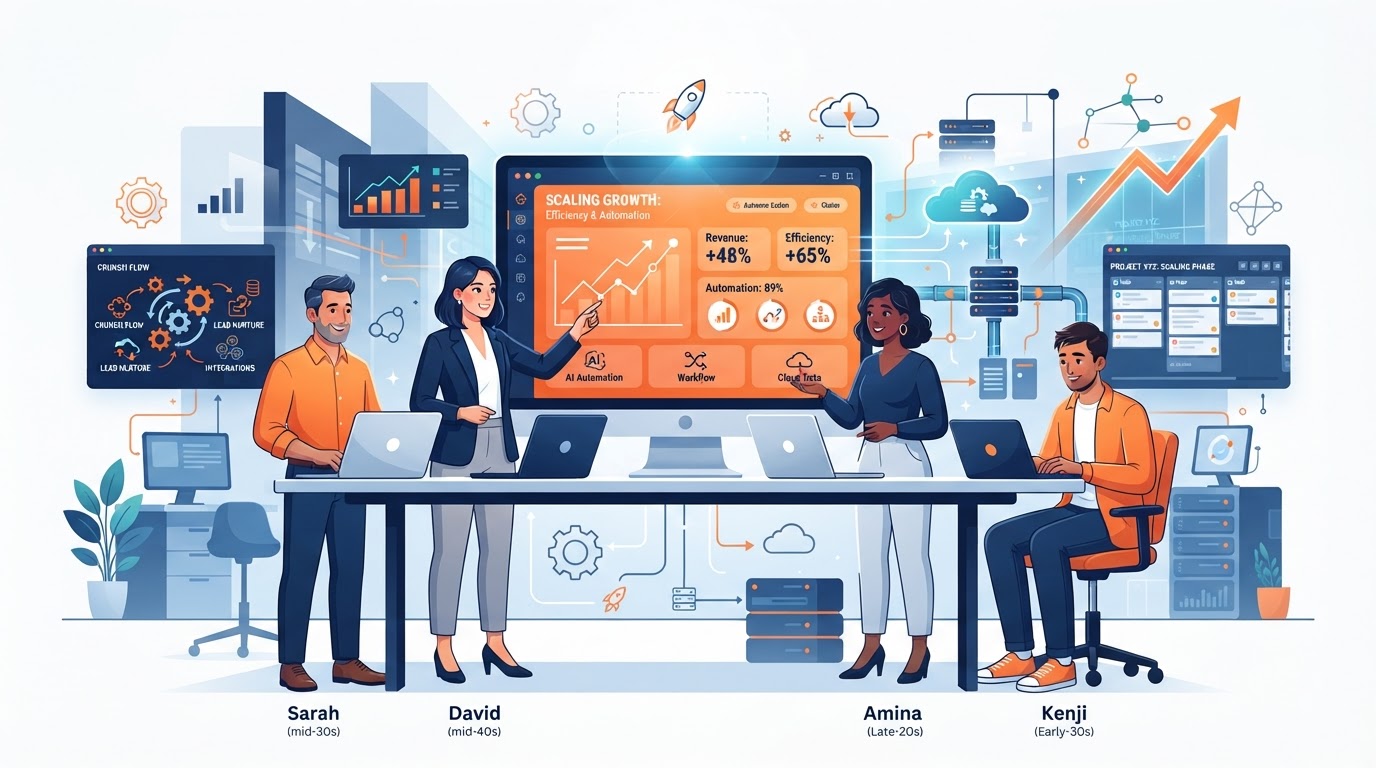
- Service businesses that automate core workflows handle 2-3x more volume with the same headcount, according to Deloitte research on operational automation.
- The three highest-impact automation areas for service businesses are lead response, quote follow-up, and admin reduction.
- Every hour of manual admin replaced by automation saves approximately £18-25 per hour in labour costs, plus the opportunity cost of that time.
- Businesses that implement automated lead response see a 21x increase in qualification rates compared to those that respond after 30 minutes, per Harvard Business Review.
- The key to scaling without hiring is not replacing people with technology, but freeing your team to do high-value work that technology cannot do.
When a service business hits a growth ceiling, the instinctive response is to hire. More calls coming in means more people to answer them. More jobs to schedule means more people to coordinate them. More customers means more people to manage the relationships. It feels logical. It is also the most expensive way to grow.
Every new hire adds salary, taxes, training time, management overhead, and risk. If your revenue grows by 50% but your headcount grows by 50% too, your profit margins stay flat. You are running faster on a treadmill. This article explains how service businesses can scale revenue without proportionally scaling headcount, using automation and connected systems.
The Math of Hiring Versus Automating
Let us start with numbers. A full-time office administrator in the UK costs approximately £28,000 to £35,000 per year including employer National Insurance, pension contributions, and holiday pay. Add training time, management overhead, and the cost of the tools they use, and the fully loaded cost is closer to £38,000 to £45,000 per year.
Now consider what that administrator actually does. According to research from Deloitte, 60-70% of administrative tasks in service businesses are repetitive and rule-based: data entry, appointment scheduling, sending confirmations, updating records, generating invoices, chasing quotes. These are tasks that follow predictable patterns and can be automated.
60-70%
of admin tasks in service businesses are repetitive and automatable, per Deloitte operational automation research
If you automate 65% of an administrator's workload, that person can handle 2-3x the volume without working longer hours. Alternatively, you can reallocate that person to higher-value work like customer relationships, complex problem-solving, or business development. Either way, you avoid hiring the next person for longer.
The Three Bottlenecks That Force Hiring
Most service businesses hire for one of three reasons. Understanding each one reveals where automation can intervene.
Bottleneck 1: Inbound Call Volume
Your marketing works. The phone rings more. But your team is on jobs, in meetings, or loading vans. Calls go to voicemail. You hire a receptionist. Then another when call volume increases further.
The alternative: an AI receptionist answers every call within 3 seconds, 24/7. It qualifies the lead, answers common questions, and books the appointment directly into your calendar. It handles unlimited simultaneous calls. It never takes a holiday. For most service businesses, this replaces the need for a dedicated receptionist and captures calls that would otherwise have been lost.
Bottleneck 2: Quote Follow-Up
You send quotes. Some customers respond. Many do not. Your team is too busy to chase them. The quotes go cold. You assume the customer was not interested. In reality, they were waiting for a nudge. You hire a salesperson to follow up.
The alternative: automated quote follow-up sequences. When a quote is sent, the system automatically sends a follow-up email after 2 days, a text message after 5 days, and a final email after 8 days. If the customer has not responded, the system flags them for a personal call. This recovers 15-25% of quotes that would otherwise have gone cold, without adding a single person to your payroll.
Bottleneck 3: Admin and Coordination
Every job generates admin: booking confirmations, appointment reminders, job sheets, invoices, review requests, customer updates. As volume grows, the admin grows proportionally. You hire an office manager. Then an assistant.
The alternative: workflow automation. When a job is booked, the system sends a confirmation email automatically. A day before the appointment, it sends a reminder text. After the job is complete, it sends an invoice and a review request. The CRM updates itself. The calendar syncs automatically. Your existing team handles 2-3x the volume without adding anyone.
The Speed Advantage
There is a second reason automation outperforms hiring: speed. Research from Harvard Business Review found that companies that respond to leads within 1 hour are 21x more likely to qualify them compared to companies that respond after 30 minutes. No human team, however dedicated, can consistently respond within 1 hour to every enquiry. Automation can.
21x
higher qualification rate for leads contacted within 1 hour versus after 30 minutes, per Harvard Business Review
This is not about replacing people with robots. It is about making sure your people spend their time on the work that actually requires a human. Answering the phone to take a name and address does not require a human. Building a relationship with a customer who is deciding between you and a competitor does. Automation handles the first so your team can focus on the second.
The goal is not to have fewer people. It is to have the same people do higher-value work. Automation handles the predictable so your team can handle the exceptional.
— Business Relauncher Growth Team
A Practical Example: From 1 Van to 6
Consider a removal company we worked with. When they started, they ran a single van. Calls went to voicemail while the crew was working. Quotes went out and nobody chased them. The owner was doing admin in the evenings. Revenue was capped at what one van and one person could manage.
We built them a system. An AI receptionist answered every call and booked surveys automatically. Quote follow-up sequences ran on their own. Appointment reminders reduced no-shows. Review requests ran automatically after each job. A dashboard showed where every enquiry came from, what it cost, and what it was worth.
The result: they now run 6 vans. The back office is still one person. The system handles the volume that would have required 3-4 administrative staff. The owner spends time on strategy and growth, not on data entry.
The Five Automations That Have the Highest Impact
If you are starting from scratch, these are the five automations that deliver the most value for the least effort:
- Automated lead response: Every enquiry gets a text and email within 60 seconds, regardless of when it comes in.
- Quote follow-up sequences: Every quote gets 3-4 automated touchpoints over 10 days to keep it warm.
- Appointment reminders: Automated SMS and email reminders 24 hours and 1 hour before each appointment.
- Review automation: An automated review request sent 24 hours after job completion, when the customer is happiest.
- Reporting automation: A weekly dashboard update showing leads, bookings, revenue, and cost per acquisition, generated automatically.
When You Should Hire Instead of Automate
Automation is not the answer to everything. You should still hire when the work requires human judgement, creativity, or relationship-building. A skilled tradesperson, a strategic salesperson, a customer success manager who builds long-term relationships. These are roles where humans outperform machines.
The rule of thumb is this: if a task follows a predictable pattern and happens the same way every time, automate it. If a task requires judgement, empathy, or adaptability, keep it human. Most service businesses have this ratio backwards. They automate nothing and hire people to do repetitive work. The businesses that scale efficiently flip the ratio.
The Bottom Line
Scaling a service business does not have to mean scaling headcount. The businesses that grow profitably are the ones that build systems to handle volume before they need to hire people to handle it. Every automation you implement delays the next hire, protects your margins, and gives your existing team the capacity to focus on work that actually moves the business forward.
If your revenue is growing but your margins are not, the problem is not that you need more people. The problem is that your systems cannot handle the volume you already have. Fix the systems first. Then decide if you still need to hire.